Independent ethnic markets face a unique challenge of
figuring out how to honor decades of family heritage
while remaining accessible and relevant to new
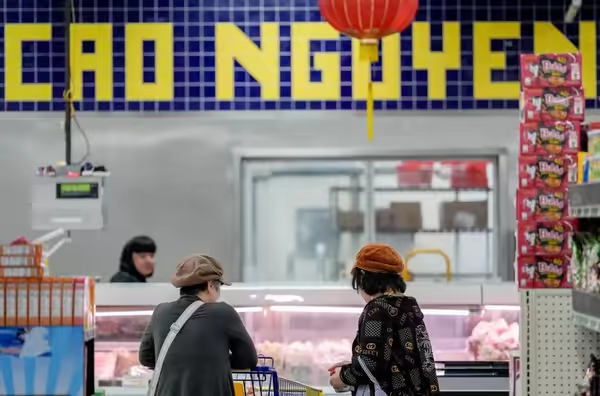
generations. Super Cao Nguyen--Oklahoma City's
cornerstone Asian supermarket since 1979--needed a
digital presence that transcended typical e-commerce.
The vision was to create an experience that celebrates
authentic cultural flavors, builds community connection,
and invites customers to discover not just the products,
but the stories behind them.
To dive in the technical detail a bit more, this project
ultimately originated with a desire to get more familiar
with choosing a modern web tech stack and understanding
its tradeoffs, especially working with React in a
real-world, content-heavy application.
Building this pushed me to think beyond just "using
tools" and instead evaluate how they shape development.
Adopting a component system like shadcn/ui alongside
Tailwind allowed me to move quickly, but more
importantly, help enforce consistency and reusability as
the interface scaled. Reinforcing the principle of how a
well-structured component layer reduces duplication and
keeps complexity manageable over time.
With mention to the performance side, there is a
practicality to optimizations that matter in
content-heavy interfaces--lazy-loading large image
assets, structuring components to avoid unnecessary
re-renders, and being mindful of how data flows through
the app. And so making these deliberate choices keeps
the experience responsive as more content is introduced.
And as any web developer would know and love, this build
forces one to be intentional about responsive design.
It's not just adapting layouts, but also thinking
through how interactions change across screen sizes.
Forcing yourself to have a clear prioritization of
content and simpler interaction patterns improves the
natural experience across all devices.
With digital transformation such as this comes an
obstacle of capturing what makes a business special. At
the heart of this project was a fundamental belief that
a well-crafted website front would extend Super Cao
Nguyen's role as a cultural gathering place beyond
typical grocery needs, while still conveying the core
promise of delivering fresh, high-quality products that
communities can trust. And rather than treating the site
as a transactional platform, we designed it as a
cultural storyteller.
Ultimately, I'm not quite a designer. But I think it can
be special when shoppers can explore curated
ingredients, pick up a few recipes, discover community
events, and connect with a store's 40+ years of family
legacy all in one place. And we can look to other
successful retail designs to inform the philosophy
around how we structure this and become centered around
restraint and authenticity. Moving away from
oversaturated retail aesthetics, we look to adopt a
premium, minimal approach that lets product imagery and
cultural content breathe. We choose being grounded in
the oriental reds, jade greens, navy accents, and cream
tones, the most common colors that familiar customers
would see on the storefront's facade. Architecture
itself can be a compelling influence to call back on in
your interface design, especially in a time where so
much of the modern UI you work with as a techie leans
toward sleek, dark, and uniform trends.
Building around user intent, and not just marketing
noise, means answering the question "What does the user
expect to find when they visit your product?". So
identifying the store's main offerings as distinct
categories, and translating those into dedicated
department journeys, allows users to navigate the space
the way they would in-store, moving intuitively between
areas like produce, the butcher, and the fresh bakery.
This reduces friction by aligning the digital experience
with familiar mental models, making it easier for users
to find what they need without second-guessing where to
go, while reinforcing the rhythm and flow already
designed in a physical market.
Departments alone, of course, won't cover all your bases
when fleshing out a content ecosystem. A robust recipes
section inspired by the former outdated website to
feature dishes bringing interest in the ingredient
selection. An events hub to celebrate cultural moments,
from Lunar New Year to community gatherings. An about
section weaving the family origin story across three
compelling narratives: community roots, a sense of
global heritage, and serving the community with
compassion. Rather than generic corporate messaging,
forming a story steeped in real history and an
authentically unique and bountiful culture brings much
more value to a landing page.
The website serves as the flagship digital presence for
a store serving upwards of 10,000 customers a week, one
of Oklahoma City's most beloved grocery destinations.
Designing with the scale of an extensive product catalog
and diverse community in mind, it was a great experience
in bridging a bit of performance-oriented engineering
and thoughtful, responsive design.
Find more information about Super Cao Nguyen on their
website